ABS, Engine Braking and Skids: The Braking Rules Your Theory Test Checks
How should you use ABS in an emergency? How can the engine control your speed? Both questions are rising in UK searches this week. Here is what the Highway Code says about braking, skids and coasting.

Two braking questions are climbing in UK searches for the theory test this week: how should you use anti-lock brakes when you need to stop in an emergency, and how can you use your vehicle's engine to control your speed? Anti-lock braking is also rising as a topic alongside the Highway Code. They belong together. Both are about what your brakes and engine really do, which is not always what people assume.
Normal braking: early and light
Rule 117 of the Highway Code says the safest way to brake is early and lightly. Brake more firmly as you begin to stop, then ease the pressure off just before the car comes to rest so the stop is not jerky. Your instructor will drill this anyway, but it is also the reasoning behind a lot of theory answers: good braking starts with seeing the need to slow down in plenty of time.
Emergency stops and anti-lock brakes
In a real emergency, Rule 118 says brake immediately, but try not to brake so harshly that you lock the wheels, because locked wheels can lead to loss of control.
Anti-lock brakes (ABS) change the technique. Rule 120 says to follow the advice in your vehicle handbook, but in an emergency apply the footbrake firmly and do not release the pressure until the vehicle has slowed to the speed you want. That is the answer the trending question is looking for: press firmly and keep pressing.
This is where older advice trips people up. You may hear about pumping the brakes. With ABS fitted, the system does that job for you, and your job is to hold the pedal down. The pedal may judder or feel odd when ABS works. That is normal, and lifting off at that moment is the mistake to avoid.
Rule 120 also contains the two facts that questions on this topic lean on. ABS should mean you keep steering control while braking hard. But you should not assume a car with ABS will stop in a shorter distance. ABS helps you steer around trouble; it does not shorten the gap you need.
Using the engine to control your speed
Whenever you lift off the accelerator with the car in gear, the engine slows you down. That is engine braking, and a lower gear makes the effect stronger. That is why the expected answer to the engine question is about changing to a lower gear, and it is most useful on long downhill stretches, where it saves you riding the footbrake all the way down.
The flip side is coasting. Rule 122 describes coasting as travelling in neutral or with the clutch pressed down, and says it reduces control because engine braking is lost, speed builds quickly downhill, heavy use of the footbrake can make it less effective, steering response suffers on bends, and it can be harder to pick the right gear when you need it. If a question mentions rolling downhill in neutral, it is almost certainly testing this rule.
Skids
Rule 119 says skids are usually caused by braking, accelerating or steering too harshly, or driving too fast for the conditions. If you skid, remove the cause: release the brake pedal fully or ease off the accelerator, and steer in the direction of the skid. Notice that the fix is the opposite of most people's instinct, which is to stamp harder on the brake.
Wet roads, ice and deep water
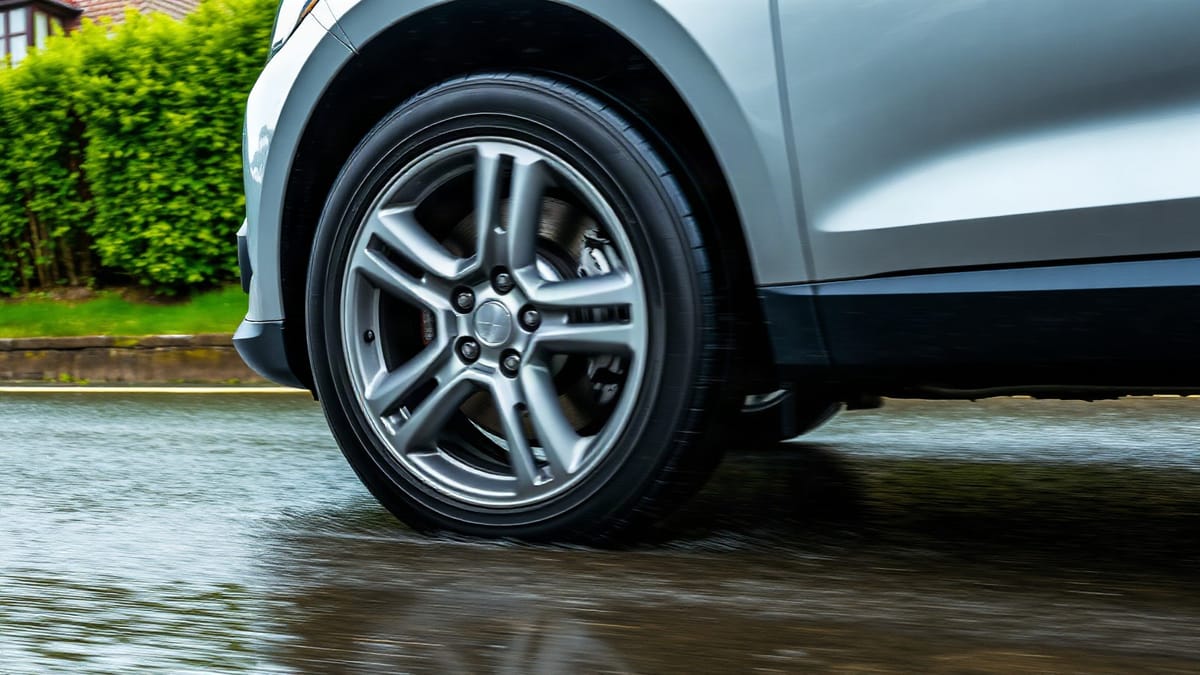
Conditions change everything. The adverse weather rules say stopping distances are at least double in the wet and can be ten times greater on ice. On icy roads, Rule 231 says drive slowly in as high a gear as possible and accelerate and brake very gently, braking on the straight before a bend. That surprises some learners who have just learned that low gears help you slow down: on ice, the aim is gentle inputs that will not break the grip.
After driving through deep water, Rule 121 says your brakes may be less effective. Test them gently at the first safe opportunity, and if they are not working fully, apply light pressure while driving slowly to dry them out.
For the numbers that go with all this, our post on stopping distances has a memory trick that works. And if you are wondering how braking questions link to the second half of the test, our guide to the new night, rain and fog hazard clips is worth a read.
Revise it with real questions
Braking questions are often worded to catch the half-remembered answer, so practise them until the right one feels obvious. Theory Test Passed gives you the DVSA licensed question bank with explanations for every answer. Try it at theorytestpassed.co.uk, or on iPhone and Android.