Zebra, Pelican, Puffin or Toucan? How to Tell UK Crossings Apart
Zebra, pelican, puffin, toucan and equestrian crossings each have their own rules. Here is how to tell them apart and what the Highway Code expects from drivers at each one.

Searches for zebra and toucan crossings shot up in the UK this week, which suggests a lot of people are revising the same chapter right now. Fair enough. Crossing questions turn up in the theory test, and the names sound more like a trip to the zoo than a set of road rules. Each crossing has one or two features that give it away, and once you know them these become easy marks. Everything here comes from the Highway Code, mainly the rules for pedestrians and the Using the road section, which covers what drivers must do.
Zebra crossings: beacons and stripes, no lights
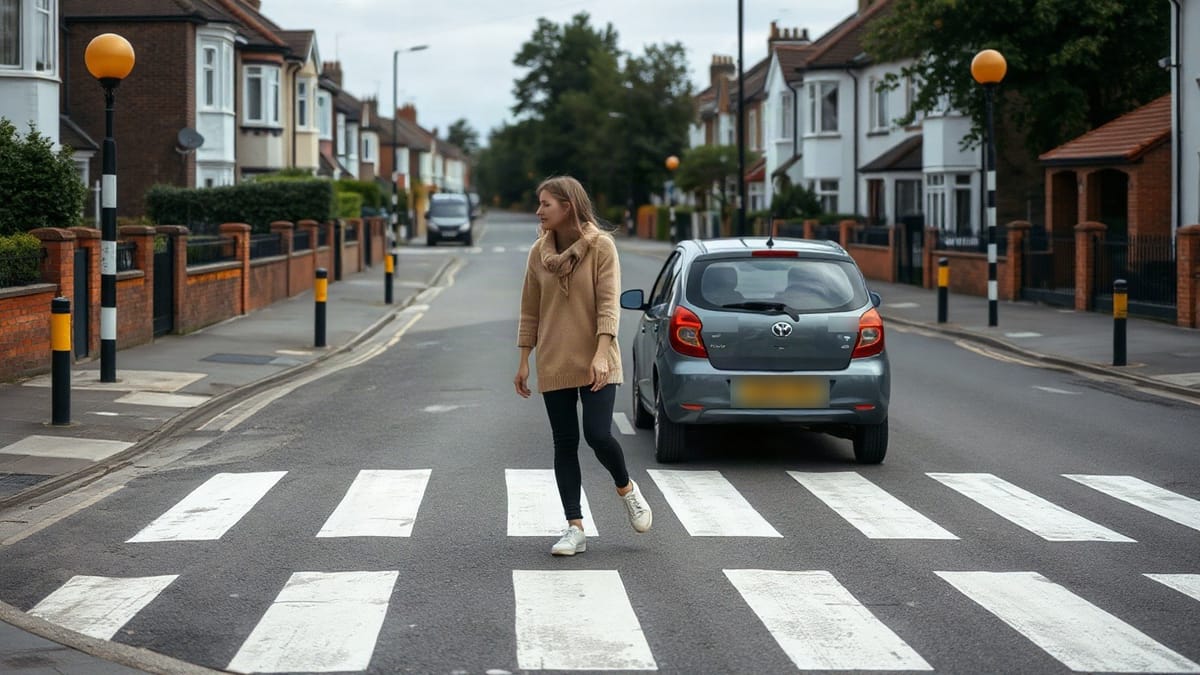
A zebra crossing has black and white stripes on the road, flashing beacons either side, and zigzag lines on the approach. There are no traffic lights, so nothing tells you to stop. The decision is yours. Rule 195 says you should give way to pedestrians waiting to cross, and you MUST give way once a pedestrian has moved onto the crossing.
Two details catch people out. If the zebra has an island in the middle, Rule 20 treats each half as a separate crossing. And Rule 195 tells drivers not to wave pedestrians across, flash their lights or use the horn to invite them over. It feels polite. The trouble is that you cannot see what the car in the next lane is doing, and your friendly wave could send someone straight into its path.
Pelican crossings: the one with flashing amber
A pelican is a light controlled crossing where the pedestrian presses a button. The feature to remember is the flashing phase. Pedestrians get a flashing green figure, and Rule 22 says they should not start to cross once it begins to flash. Drivers see a flashing amber light at the same point. Under Rule 196, when the amber light is flashing you MUST give way to any pedestrians on the crossing. If it is clear, you can go on.
This is a favourite trap. Flashing amber at a pelican does not mean stop and wait for green, and it does not mean go. It means give way to anyone still crossing, then carry on once the crossing is empty.
One more pelican rule: where the crossing runs straight across a central island, Rule 197 says you MUST wait for pedestrians crossing from the other side of the island. If the two halves are staggered and not in line, Rule 28 treats them as two separate crossings.
Puffin crossings: no flashing phase at all
From the driver's seat a puffin looks a lot like a pelican. The difference is on the pavement. Rule 23 explains that on a puffin the red and green figures sit above the control box on the pedestrian's own side of the road, and there is no flashing green figure phase. So there is no flashing amber for you to deal with either. That rule belongs to pelicans.
What you still need is Rule 198: give way to anyone still crossing after the signal for vehicles has changed to green. Someone who is slow, or who set off late, still gets to finish crossing.
Toucan and equestrian crossings: shared with bikes and horses
The toucan name is a pun: two can cross. Rule 25 says pedestrians and cyclists see the green signal together, and cyclists are permitted to ride across. So do not expect only walkers. A bike can leave the kerb and be across your lane far quicker than someone on foot.
Equestrian crossings are for horse riders. Rule 27 describes pavement barriers, wider crossing spaces, horse and rider figures in the light panels, and a control panel set higher up for riders.
For toucans, puffins and equestrian crossings, Rule 199 says do not enter the crossing unless you can clear it completely. Stopping halfway over in a queue leaves pedestrians, cyclists or riders picking their way round your bonnet.
Rules that apply at every crossing
Some rules do not care what type of crossing it is. Rule 191 says you MUST NOT park on a crossing or in the area covered by the zigzag lines, and you MUST NOT overtake the moving vehicle nearest the crossing, or the vehicle nearest the crossing that has stopped to give way to pedestrians. That second part matters. If a car ahead has stopped at a zebra, assume there is someone in front of it you cannot see.
Rule 192 asks you to keep crossings completely clear in slow or queuing traffic. Rule 194 says do not harass pedestrians by revving your engine or edging forward. If you have ever crept towards a crossing while someone was still on it, that is exactly what the rule is aimed at. Crossings also sit alongside the pedestrian priority rules at junctions, which we cover in Rule H2 and Rule 170 explained.
A quick way to remember them
Here is the version I would put on a flashcard. Zebra: beacons and stripes, no lights. Pelican: the only one with flashing amber. Puffin: figures on the near side, no flashing phase. Toucan: two can cross, so bikes too. Equestrian: horses, with a higher button.
Then test yourself with pictures rather than names, because on the road you see the crossing, not a label. Our guide to road signs, the topic most learners get wrong, and the post on bus lanes, cycle lanes and tram signs work well in the same revision session.
If you want to practise crossing questions alongside the rest of the question bank, Theory Test Passed has revision and full mock tests on the website, and on the iPhone app and Android app.