Security Checks at the Theory Test Centre: What Actually Happens
Arriving 15 minutes early, powering down your smart watch, and a handheld metal detector: here is the full sequence of identity and security checks at a UK theory test centre, and the mistakes that cost people their fee.

Most learners spend weeks revising road signs and stopping distances, then walk into the test centre with no idea what the first fifteen minutes will involve. That gap causes a surprising amount of anxiety, and occasionally it causes a wasted fee. The screening process at a theory test centre is stricter than people expect, and knowing the sequence in advance removes almost all of the stress.
Here is exactly what happens between arriving at the door and sitting down at the screen.
Arrive fifteen minutes early, and mean it
You must arrive 15 minutes before your test is due to start. This is not padding for the DVSA's convenience, it is the time the checks actually take. If you are late, your test is cancelled and you lose your money, and you will have to book and pay for another one.
Plan for the journey going wrong rather than going well. Traffic, parking and finding an unfamiliar building will eat that margin faster than you think, and there is no discretion to squeeze you in afterwards.
One thing worth telling whoever drives you: there is no waiting area at the test centre for anyone who comes with you, adults or children included. If a parent or friend is bringing you, they will need to wait in the car or somewhere nearby, so agree the plan before you set off rather than discovering it on the doorstep.
Every device goes off before you walk in
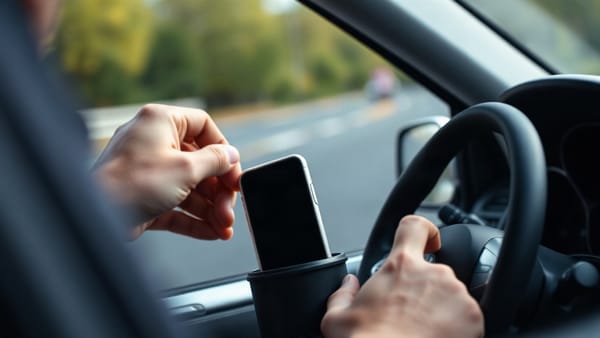
You must turn off all electronic devices before you enter the test centre. That means mobile phones, smart watches and fitness tracking devices. Not silent, not do-not-disturb: off.
This one has teeth. If you bring a device you cannot turn off, you will not be allowed to take your test. It is worth a moment's thought if you wear a fitness tracker you have never actually powered down, or a watch whose off switch you would struggle to find under pressure. Practise at home, or leave it behind entirely.
There is one exception. If you use a monitoring device for a medical condition, you can bring it, but only if the DVSA approved it when you booked. If you did not declare it at booking, you need to cancel your appointment and rebook, selecting yes when asked whether you need support. Cancelling with at least three working days' notice gets you a full refund, so deal with this as soon as you spot it.
Your belongings go in a locker
You can only take personal items into the test room if the DVSA approved them when you booked. Everything else goes into a locker, or into a clear plastic box kept somewhere safe if your centre does not have lockers.
That covers small bags, coats and jackets, hats and caps, earphones, phones, watches, wallets and purses, books and pens, and anything in your pockets. Bring a small bag rather than a large one, and honestly the easiest approach is to arrive carrying as little as possible. Licence, keys, and that is about it.
The identity and security checks
Two checks stand between you and the test room, and you have to pass both.
The identity check is straightforward. Staff need to see your face clearly so they can match you to your photo ID. If you wear headgear for religious or cultural reasons, you will be asked to remove it so your face is visible, and you can do this in a private area with a female member of staff where possible.
The security check is the part people are not expecting. Staff are looking for anything that could be used to cheat, and they will ask you to show your pockets are empty, roll up your sleeves, pat yourself down, show the top of your socks, stay still while they pass a handheld metal detector around you, and show them your ears so they can confirm there is no hidden earpiece.
It sounds more intimidating written down than it feels in practice. Staff will not touch you at any point, and they run this dozens of times a day without drama. The one rule to know is that refusing the check means you do not sit the test.
Why the checks are this thorough
Cheating at the theory test is a criminal offence, not a policy breach. People have been sent to prison for it and banned from driving. Organised impersonation, where someone sits the test in another candidate's name for a fee, is exactly what the screening is built to stop.
Seen that way, the process is on your side. It protects the value of the certificate you are about to earn, and it means nobody passes without doing the work you have been doing.
Walking in prepared
None of this is difficult once you know it is coming. Leave early, bring your photocard licence, carry almost nothing, and power your devices down in the car park rather than at the desk. Do that and the checks become a two minute formality on the way to the only part that actually counts.
The rest is preparation. Theory Test Passed is a DVSA licensed platform with the full question bank and hazard perception clips, so by the time you reach that desk the test itself feels like familiar ground.
Start free at theorytestpassed.co.uk.
Related reading: The Silent Video in Your Theory Test: How the Three Video Questions Work and What Language Is the Theory Test In? The English and Welsh Only Rule.