Passing Horses on the Road: 10 mph, 2 Metres and the Rules for Animals
The Highway Code gives drivers two clear numbers for horses: slow to 10 mph and leave at least 2 metres. Here is how that works on a real country lane, plus the rules for herds and loose ponies.

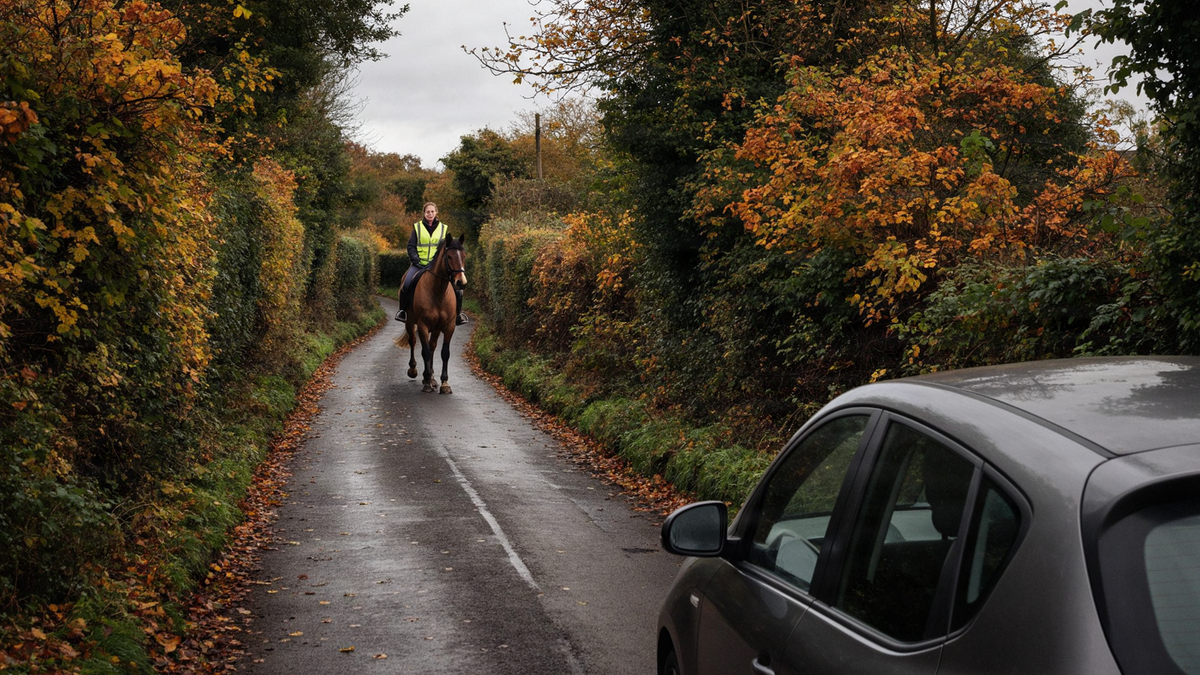
If you learn in a town, the first horse you meet on the road can come as a shock. It is big, it is slow, and you can feel a queue building behind you. That pressure is exactly why the Highway Code gives two simple numbers to hang on to. Both of them come up in the theory test, and both matter far more on a dark country lane than they do on paper.
The two numbers: 10 mph and 2 metres
Rule 215 says that when you see a horse on the road, you should slow down to a maximum of 10 mph. When it is safe to pass, go wide and slow, leaving at least 2 metres of space. Rule 163 on overtaking says the same: pass horse riders and horse drawn vehicles at under 10 mph with at least 2 metres of room.
Two metres is wider than most people think. On a narrow lane it often means you cannot pass at all until the road opens up or the rider pulls into a gateway. That is fine. Waiting thirty seconds behind a horse costs you nothing.
Why horses get extra care
A horse is an animal with its own reactions. It can spook at a noise or a sudden movement and move sideways into the road without warning. That is why Rule 215 tells you not to sound your horn or rev your engine near a horse, and why Rule 214 adds that you should not accelerate sharply once you have passed animals either. The noise from a car pulling away hard can startle a horse that has just been passed safely.
Under the hierarchy of road users, drivers carry more responsibility because they can do more harm. Rule H3 also says you should not cut across horse riders or horse drawn vehicles going ahead when you turn at a junction.
Roundabouts and riders in the left lane
One that catches learners out: Rule 186 says cyclists, horse riders and horse drawn vehicles may stay in the left hand lane even when they are going all the way round a roundabout. So a rider in the left lane is not necessarily taking the first exit. Take extra care entering, and do not cut across them. Our guide to roundabouts and mini roundabouts covers the lane rules for everyone else.
Herds, loose ponies and animals in the road
Rule 214 covers animals in general. Drive slowly when passing them, give them plenty of room and be ready to stop. Slow down at bends and on narrow country roads, and look out for animals on unfenced roads. If a herd is blocking the road, stop and switch off your engine until they have left.
Rule 215 also mentions feral and semi feral ponies in places such as the New Forest, Exmoor and Dartmoor. Treat them the same way you would a ridden horse. They are used to cars, which makes some drivers careless around them, and they still wander into the road.
Reading the rider
Riders often signal to drivers, either to slow down or to say thanks. Rule 212 points out that if a rider looks over their shoulder, they may be about to pull out or turn, so give them time and space. Leave more room in bad weather, in high winds and at night, when a rider is much harder to see even in hi vis.
A personal take: the drivers who get this wrong are rarely reckless. They are in a hurry and assume the horse will carry on in a straight line. Assume it might not. If you want the cyclist version of the same thinking, read the Dutch Reach and close pass rules.
What the theory test asks
Expect questions with a horse rider ahead on a narrow road, a rider on a roundabout, or a herd of animals across the road. The answers that score are the patient ones: slow down, pass wide, stay quiet, and switch off for a herd. Anything involving the horn, a quick overtake or a squeeze past is the wrong answer.
Start free at theorytestpassed.co.uk.