Theory Test in English: Learn the English Words the Questions Use
Revising in your own language is a great start, but the theory test is in English. Our new English test words feature lets you tap any key word in a question to see what it means in your language and hear it said.

One of the most common questions we see is whether you can do the theory test in a different language. In Great Britain the answer is mostly no: the GOV.UK page on theory test support lists the voiceover in English or Welsh, and there is a British Sign Language option, but no other languages. We cover the rule itself in what language is the theory test in. This post is about what to do about it.
The problem is usually one word
If you revise with translations, you can understand a rule perfectly in Polish or Romanian and still get the question wrong in English. Not because you do not know the rule, but because one word in the question is new to you. Hard shoulder. Contraflow. Central reservation. If you do not know that "verge" is the strip of grass at the side of the road, a question about where to stop can look like nonsense.
These words are not everyday English. Plenty of fluent speakers would struggle to define "contraflow". So learning them is not about your English being weak; it is about learning the vocabulary of the test, the same way you would learn the signs.
Tap any word in a question
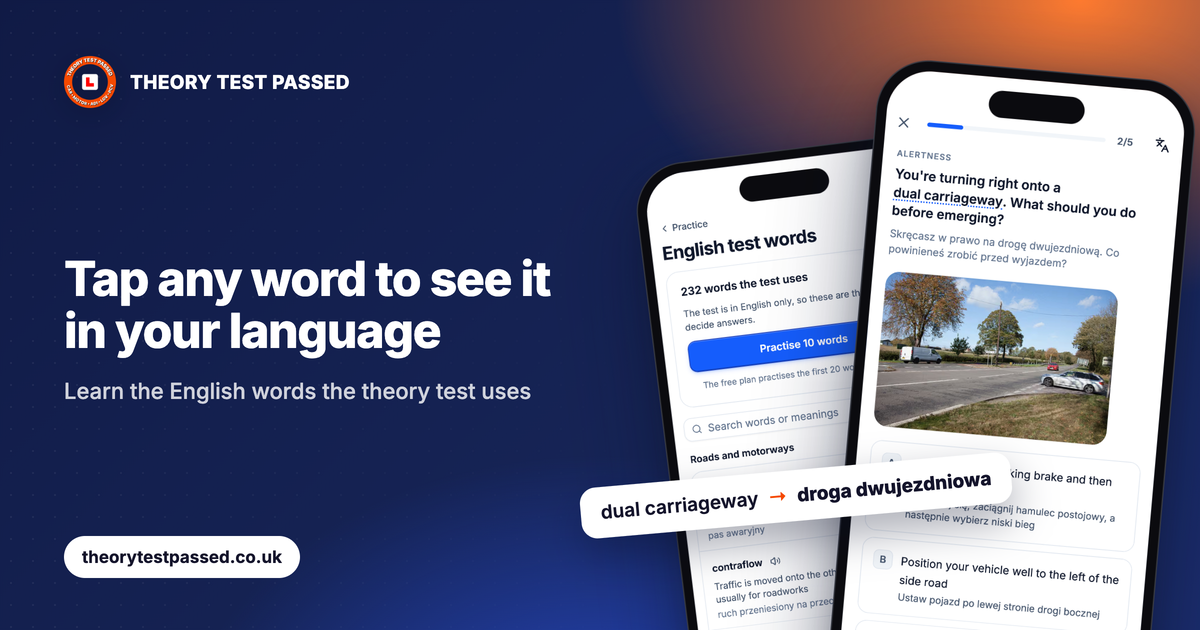
In Theory Test Passed, when you practise with translations on, the key test words in each question are underlined. Tap one and a card opens with a plain English meaning, the translation in your language and a button to hear it said. Close it and you are back on the question.
For example, in a question about turning right onto a dual carriageway, you can tap "dual carriageway" and see "a road with a central strip dividing traffic going each way", then "droga dwujezdniowa" in Polish. Mock exams stay in English only with no help, like the real test, which is the right way round: learn with support, then prove you can do without it.
Learn the words in short rounds
Under Practice there is now an English test words page. It lists the words grouped by subject, such as roads and motorways, each with its meaning, translation and a speaker button. You can search in English, by meaning or in your own language.
Practise 10 words starts a quick round. Each card asks what a word means, or which word matches a meaning, with two options to begin with. The wrong option is a near miss on purpose, so you cannot guess from a mile away. Once you know a word, you get three options, then four. Missed words come back after one, three and seven days if you are signed in, which is a simple way of making sure they stick.
Translations are available in Polish, Portuguese, Punjabi, Romanian, Turkish and Welsh. The free plan lets you practise the first 20 words.
A few words worth learning first
From the roads and motorways group, these come up a lot:
Hard shoulder: the lane on the far left of a motorway, for emergencies only. Contraflow: traffic moved onto the other side of the road, usually for roadworks. Slip road: the road you use to join or leave a motorway. Central reservation: the strip between the two sides of a motorway or dual carriageway. Kerb: the raised edge between the road and the pavement. Verge: the strip of grass or earth at the side of a road.
If any of those were new to you, that is exactly the point. Learn them now and they will not cost you a mark later.
How to use it alongside your revision
Do one round of words before each practice session. It takes two minutes. Then practise questions with translations on and tap any underlined word you are not sure of. Before your test, switch translations off and try a full mock in English only. If you can pass that comfortably, you are ready. Our list of what to do after you pass is there for when you get there.
Start free at theorytestpassed.co.uk.