Stop or Give Way? Junction Signs, Box Junctions and Dual Carriageways Explained
The Stop sign and the Give Way sign look like they mean the same thing. They do not. Here is what each one asks of you, plus the box junction and dual carriageway rules that catch learners out.

Searches for the give way sign jumped this week, and it is easy to see why. Junctions are where a lot of theory questions live, and the two signs that control them look like a pair. They are not. One asks you to judge. The other takes the judgement away from you.
The Stop sign: you stop, every time
The Stop sign is the eight sided red sign, and it comes with a solid white line across the road. Rule 171 of the Highway Code says you MUST stop behind that line, then wait for a safe gap before moving off. Capital letters in the Highway Code mean the law, not advice.
The bit people miss: the stop is not conditional. An empty main road, perfect visibility, nobody for half a mile, and you still bring the car to a complete stop behind the line. The whole point of the sign is that the decision is made for you. Rolling over the line at walking pace because it looked clear is still not stopping, and in a theory question the answer is always the full stop.
The Give Way sign: stop only if you need to
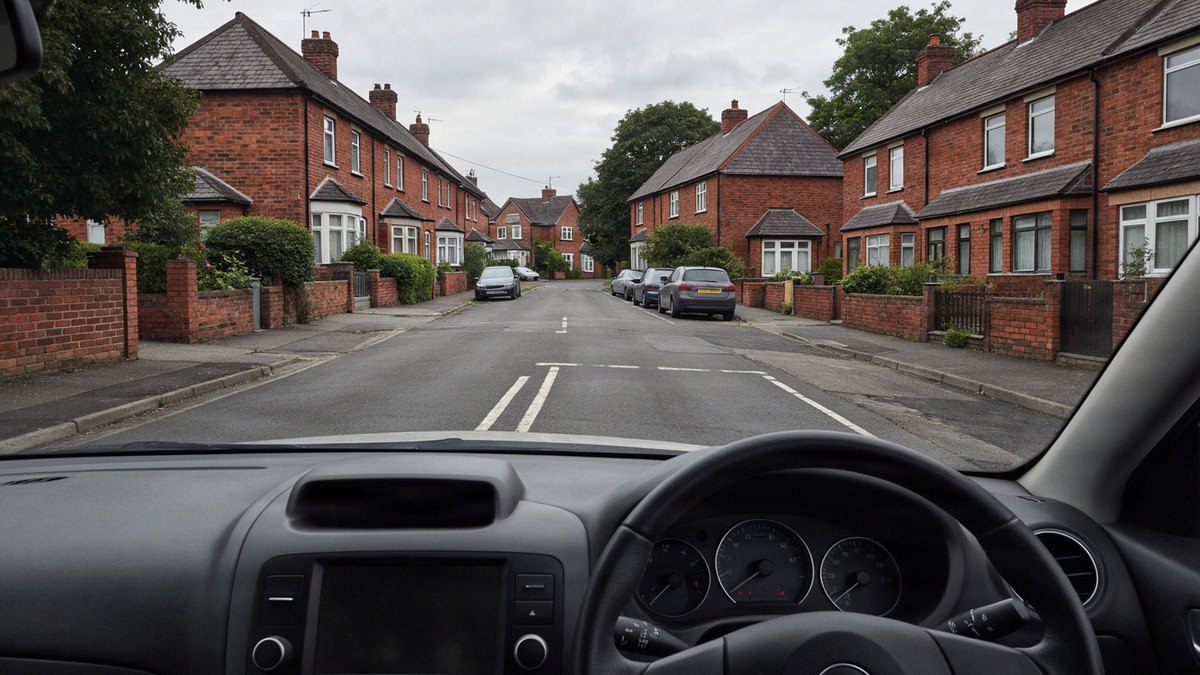
The Give Way sign is the upside down triangle, and the road marking is a pair of broken white lines across your lane. Rule 172 says you MUST give way to traffic on the main road when you emerge from a junction with broken white lines.
Giving way does not mean stopping. If you can see the road is clear well before you reach the lines, you can carry on. If it is not clear, you slow down and stop behind the lines. A good way to remember it: solid line, solid stop; broken line, it depends.
You may have learned that triangles warn and circles give orders, which we covered in our guide to road sign shapes. Stop and Give Way break that pattern on purpose. The Know Your Traffic Signs guide lists them as exceptions to the shape and colour rules, there to give them extra prominence. Both are orders, even though one of them is a triangle.
Whatever the sign, the people come first
Rule 170 asks you to take extra care at junctions, to watch for cyclists, motorcyclists and pedestrians who can be hard to see, and to give way to pedestrians crossing or waiting to cross the road you are turning into. If that last part surprises you, our post on Rule H2 and Rule 170 goes through it properly. And do not cross or join a road until the gap is big enough to do it safely. A gap you have to hurry into is not big enough.
Box junctions: your exit has to be clear
The yellow criss-cross box has one main rule. Rule 174 says you MUST NOT enter the box until your exit road or lane is clear. The test is not whether the box itself is empty. It is whether you can get out the other side.
There is one exception the theory test likes to ask about. You may enter the box and wait when you want to turn right and the only thing stopping you is oncoming traffic, or other vehicles waiting to turn right. That is the only time waiting inside the box is fine. At signalled roundabouts, do not enter the box unless you can cross it completely without stopping.
Crossing a dual carriageway: look at the gap in the middle
Turning right across a dual carriageway, or going straight over one, gets its own rule. Rule 173 asks you to check whether the central reservation is deep enough to protect the full length of your vehicle.
If it is, treat each half as a separate road. Cross the first half, wait in the central gap, then cross the second half when it is safe. If it is too shallow and your back end would stick out into the lane behind you, wait until you can cross both carriageways in one go. Learners tend to forget this changes with the vehicle. A gap that fits a small hatchback may not fit a car towing a trailer.
Traffic lights at junctions
Two short points from Rules 175 and 176. On amber you may only go on if you have already crossed the stop line or are so close that you cannot stop safely. And if the lights are not working, treat the junction as unmarked and go with great care. Nobody has priority, so assume nobody will give it to you.
Junctions reward a simple habit: read the line on the road before you read the traffic. The line tells you what the law expects, and the traffic tells you when it is safe to do it. If roundabouts are next on your list, our guide to roundabouts and mini roundabouts follows on from here.
If you want to drill these until they are automatic, Theory Test Passed has the full DVSA licensed question bank and hazard perception clips. Start free at theorytestpassed.co.uk.