Theory Test and Dyslexia: Practise With Read Aloud and a Dyslexia-Friendly Font
Every question in Theory Test Passed can now be read aloud, like the voiceover you can ask for at the test. You can also choose a coloured background, larger text, wider spacing or the OpenDyslexic font.

If you have dyslexia, the theory test can feel like a reading test with some driving in it. It should not be. The DVSA offers real support on the day, and you can practise in a way that matches it. We have just added read aloud and reading settings to Theory Test Passed, and this post covers both: what you can ask for at the test, and how to practise for it.
What support you can get at the theory test
According to the GOV.UK page on reading difficulties, disability and health conditions, you can ask to hear the test through headphones when you book. The voiceover is available in English or Welsh, and you can listen to the questions and answers as many times as you need to.
If you send proof that you have reading difficulties, you can also get other support. That can include more time for the multiple choice part, a member of staff to read the instructions and questions aloud and record your answers, or a member of staff to reword questions so they are easier to understand. They cannot change the technical words you need to know, and you still answer every question yourself. The proof can be an email, letter or report from a teacher or other educational professional, a doctor or medical professional, an occupational therapist, or an online dyslexia screening product. You are told how to send it when you book.
We wrote more about the options in extra time, headphones and readers. The short version: ask. Plenty of people who would qualify never do, usually because they assume it is complicated.
Practise the way you will sit the test
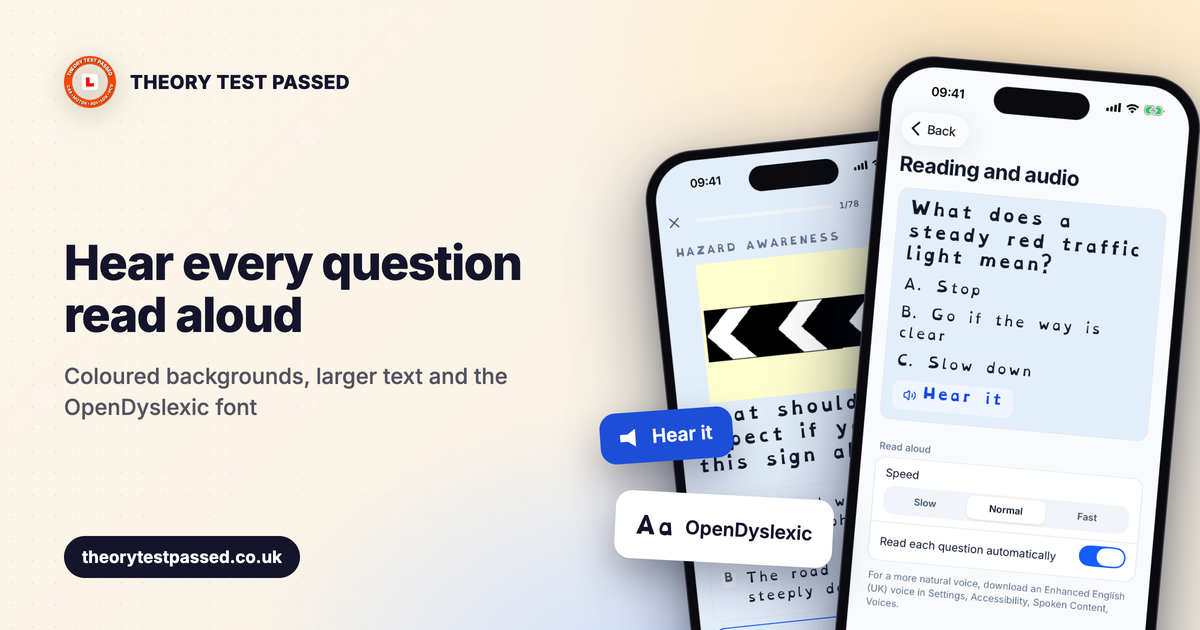
If you are going to hear the test through headphones, it makes sense to revise by listening too. In Theory Test Passed, every question, answer, feedback message and explanation can now be read aloud in English, like the voiceover at the test. Tap Hear it on any question, or switch on auto-read and each question is read as it appears. The part being read is highlighted, so you can follow along with your eyes as well.
You can set the speed to slow, normal or fast. Our advice is to start on slow while you get used to the wording, then move to normal before your test. Road signs read out too: tap a sign to hear its name and meaning, which helps if you learn better by hearing than by looking.
One honest note: the voice comes from your phone or browser, not a recording. On an iPhone you can get a more natural voice by downloading an Enhanced English (UK) voice in Settings, Accessibility, Spoken Content, Voices. Because it uses the voices on your device, read aloud also works offline in the app.
Coloured backgrounds, larger text and OpenDyslexic
Some people find black text on bright white tiring after a few minutes. You can now choose a coloured background (cream, blue, green, peach or grey), make the text up to 150% larger, add wider spacing, or switch to OpenDyslexic, a typeface designed with dyslexic readers in mind. These are under Account, then Reading and audio, and there is an Aa button on practice questions so you can change them mid-session.
Try a few combinations rather than picking one and sticking with it. What helps is personal. Some people like the font and hate the tint; for others it is the other way round. Your settings follow you between the app and the website, so you only set them up once.
A revision routine that works with dyslexia
Short sessions beat long ones. Ten questions with read aloud on, then a break, is worth more than an hour of skimming. Read the question twice before looking at the answers; the theory test likes small words such as "not" and "most" that change the whole meaning. When you get one wrong, listen to the explanation rather than skipping it.
And leave time for hazard perception, which is video, not reading. For a lot of dyslexic learners it is the easier half of the test, so it is worth banking those marks. Our post on the clicking mistake that scores you zero covers the main trap.
Start free at theorytestpassed.co.uk.